
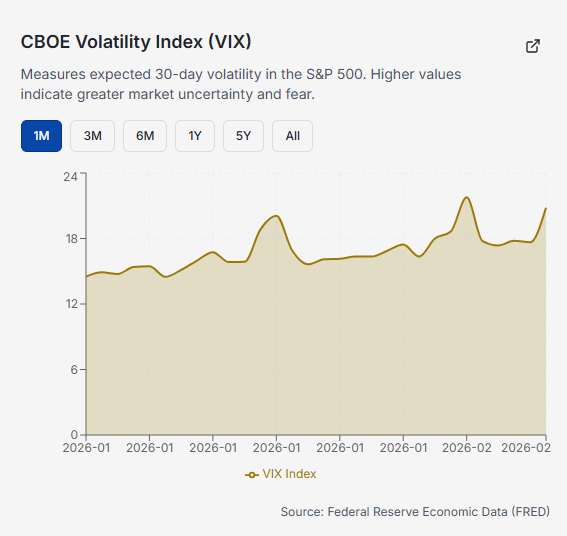
Volatility has risen even as growth improved.
Neutral Doesn’t Mean Static
We remain in a “Mixed Signals – Neutral Stance” regime this month. But neutrality is not stasis.
Beneath the unchanged label, internal dynamics shifted meaningfully between January and February, particularly in growth momentum, volatility, and risk appetite.
Forecasting discipline requires watching how regimes evolve internally, not just how they’re categorized.
Executive Summary
- Growth strengthened materially month-over-month.
- Inflation cooled slightly.
- Labor stabilized marginally.
- Volatility increased.
- Risk appetite cooled (Bitcoin down, Gold steady).
- Yield curve remains positive but flatter.
Headline: Still Neutral.
Subtext: Higher internal tension.
Key Data: January vs. February
Growth
| GDPNow | January | February |
|---|---|---|
| Growth estimate | 2.7% | 4.2% |
Growth improved materially.
This reduces near-term recession probability and strengthens the expansion narrative.
Inflation
| CPI | January | February |
|---|---|---|
| Year over year | 3.0% | 2.8% |
Modest cooling.
Disinflation continues, but not aggressively.
Models expecting rapid policy easing may be early.
Labor
| Unemployment | January | February |
|---|---|---|
| Rate | 4.4% | 4.3% |
Marginal improvement.
Labor deterioration signal weakened slightly.
Yield Curve
| 10Y–2Y | January | February |
|---|---|---|
| Spread | 51 bps | 39 bps |
Still positively sloped.
Expansion pricing remains intact, but flattening bears monitoring.
Volatility
| VIX | January | February |
|---|---|---|
| Index level | 16.8 | ~21 |
This is meaningful.
Growth improved.
Yet volatility rose.
That divergence suggests rising uncertainty beneath improving macro prints.
Risk Appetite
| Year over year | January | February |
|---|---|---|
| Gold | +50% | +52% |
| Bitcoin | +7% | –11% |
Speculative appetite cooled significantly.
Capital rotated toward defensive hedges.
What I’m Watching Next
- Does volatility continue to rise despite strong growth?
- Does the yield curve flatten further?
- Does sentiment remain weak while GDP remains strong?
- Does risk appetite continue diverging between gold and speculative assets?
The current regime is neutral, but more internally stressed than last month.
In forecasting systems, this is where fragility increases. Not because signals are negative, but because signals conflict.
If your forecasting framework relies heavily on recession anticipation or rapid policy easing, this may be a useful moment to stress-test regime assumptions.
I offer independent forecasting diagnostics for small firms and emerging managers seeking structural clarity.