
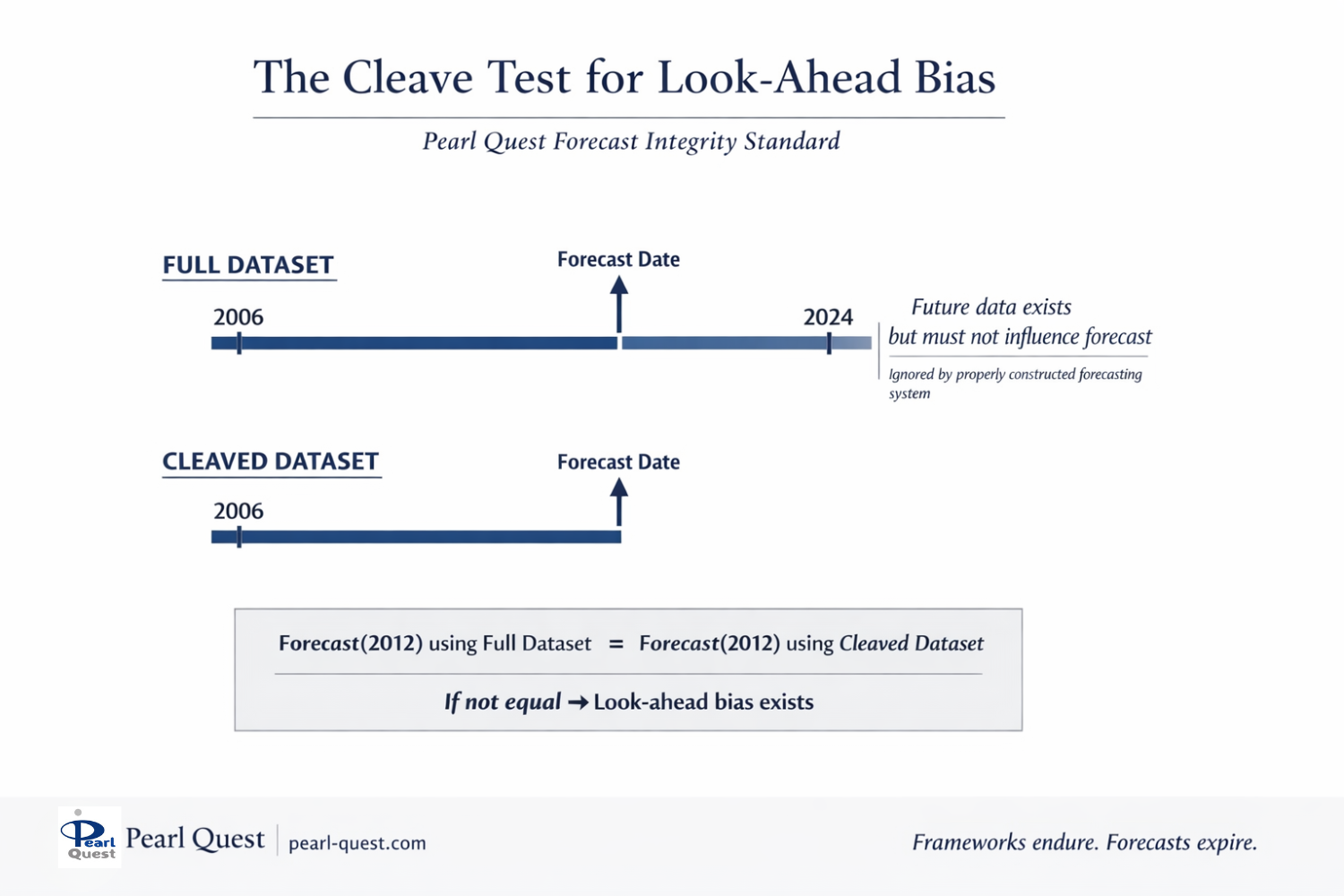
Practical note: In simple forecasting systems the cleave test can often be verified through direct equality of forecasts. In more complex pipelines, small differences may arise from structural factors such as rolling-window estimation or insufficient historical context. In those cases, intermediate outputs may need to be examined to determine whether the difference reflects true information leakage or a change in the estimation environment.
Forecasting systems operate under a simple but unforgiving constraint: they must respect the arrow of time. In financial forecasting and machine-learning models for asset returns, violating this constraint leads to look-ahead bias, one of the most common errors in backtesting predictive models.
At each forecast origin, predictions must be based solely on information that was available at that moment. Any inadvertent incorporation of future information, known as look-ahead bias, can distort performance estimates and undermine the integrity of the entire forecasting process.
Look-ahead bias rarely appears as an obvious error. More often, it enters quietly through preprocessing steps such as feature selection, normalization, correlation filtering, or other operations performed outside the temporal structure of the forecasting system.
The Cleave Test
This test applies specifically to forecasting systems that use rolling or expanding window estimation to simulate real-time prediction.
Consider a dataset spanning many years, and suppose your system generates forecasts at each point in history using only prior information.
To verify that this is truly the case, perform two runs.
Run 1: Full Dataset
Use the entire dataset (for example, 2006 through 2024) and generate forecasts for a historical date such as June 30, 2012.
Run 2: Cleaved Dataset
Now truncate the dataset at June 30, 2012, removing all future data, and re-run the forecasting system.
Then compare the forecasts produced for June 30, 2012.
If the system is free of look-ahead bias, then in a perfectly isolated forecasting system the forecasts should be identical. The system should have no knowledge of whether future data exists.
One important practical detail is that the cleaved dataset must still contain sufficient historical data for the forecasting system to operate normally.
If the truncation removes too much of the historical sample, the forecasting pipeline may technically run but still behave differently because the model has not yet accumulated enough training history. In those cases, a failed cleave test does not necessarily indicate look-ahead bias. It may instead indicate that the truncated dataset does not provide the same estimation environment as the full dataset.
Why This Test Works
Rolling and expanding window systems are designed to simulate real-time deployment. At each forecast origin, the model is estimated using only information available at or before that date.
Under this framework, forecasts generated at a given time should be invariant to whether future data exists elsewhere in the dataset.
If truncating future data changes historical forecasts, it suggests that some component of the pipeline (often preprocessing, feature selection, or scaling) is incorporating information that was not available at the forecast origin.
This violates the temporal integrity required for credible forecasting.
The Production Standard
Any allocator-grade forecasting system should be able to pass the cleave test.
If forecasts change when future data is removed, the issue is not necessarily catastrophic. But it must be understood and resolved as part of the normal process of production hardening.
Forecast integrity is not optional. It is structural.
Interpreting the Diagram in Real Forecasting Systems
The diagram above illustrates the conceptual logic of the cleave test.
In principle, a forecasting system should produce identical forecasts whether future data exists in the dataset or not. If a forecast generated for June 2012 changes when observations after June 2012 are removed, the system is incorporating information that was not available at the forecast origin.
Conceptually, this is correct.
However, modern forecasting pipelines are rarely simple enough for this equality condition to be verified with a single manual comparison.
Running a forecasting system on a full dataset and then on a truncated dataset may produce forecasts that differ slightly even when no look-ahead bias exists. These differences can arise for structural reasons unrelated to future information leakage.
Examples include:
- rolling-window aggregation differences
- numerical estimation path changes when sample sizes differ
- ensemble averaging that depends on the number of windows
- post-forecast transformations such as scaling or orientation
When these components exist, a direct comparison of final forecasts may suggest a problem even though the forecasting pipeline respects the arrow of time.
Diagnosing Differences in Practice
For this reason, verifying temporal integrity in complex forecasting systems often requires examining the forecasting pipeline step by step rather than relying solely on a comparison of final outputs.
In our implementation, the cleave test can be evaluated across multiple stages of the forecasting architecture, including:
- training data construction
- feature filtering and preprocessing
- model estimation within each rolling window
- per-window forecast generation
- aggregation of forecasts across windows
- post-processing transformations
- final production forecasts
By comparing outputs at each stage, it becomes possible to identify exactly where two runs begin to diverge.
If divergence occurs before model estimation, the issue typically lies in preprocessing.
If divergence occurs during aggregation, the difference may reflect changes in available windows rather than information leakage.
In this way, the cleave test becomes more than a simple pass-fail check. It becomes a diagnostic tool for verifying the temporal integrity of the forecasting architecture.
A Practical Interpretation of the Cleave Test
The core principle of the cleave test is simple:
future information must not influence past forecasts.
In practice, verifying this condition requires examining how information flows through the forecasting system.
What matters is whether the data used to generate each forecast was available at the forecast origin.
If the feature construction, model estimation, and prediction steps all rely only on information available at that moment in time, the system respects the arrow of time.
Under these conditions, small numerical differences in final forecasts may arise from implementation details, but they do not indicate look-ahead bias.
A Practical Lesson from a Rolling Forecast System
During development of a research forecasting engine at Pearl Quest, we encountered a useful example of this issue.
The system generates monthly forecasts of one-year-ahead returns using a rolling estimation window and a Generalized Additive Model (GAM). To ensure stable estimation, each model requires a minimum of 60 months of training data.
The historical dataset begins on June 30, 2006.
When we initially performed a cleave test at June 30, 2012, the forecasting system technically ran but failed the equality test. Forecasts produced using the full dataset differed from those produced using the truncated dataset.
At first glance, this suggested the presence of look-ahead bias.
However, the issue turned out to be structural rather than informational.
By cleaving the dataset at June 2012, the forecasting system was left with only the minimum amount of historical data required to estimate the first rolling model. In effect, the system was just beginning its estimation history.
When the same forecasting pipeline was run on the full dataset, later forecasts incorporated a much richer rolling history of estimated models and forecast windows.
The forecasting system therefore behaved differently, not because future information was leaking into the model, but because the historical estimation environment was materially different.
To verify this, we repeated the cleave test using a truncation point at June 30, 2014, by which time the forecasting system had accumulated a mature rolling estimation history.
Under those conditions, the forecasts produced by the full dataset and the truncated dataset aligned as expected.
The system passed the cleave test.
The lesson is subtle but important:
A cleave test should truncate future information, not necessary historical context.
If the truncated dataset leaves the forecasting system at the very beginning of its estimation history, differences between runs may reflect changes in the estimation environment rather than look-ahead bias.
For rolling forecasting systems, especially those predicting long-horizon returns, cleave tests should therefore be conducted at dates where the system has already accumulated a stable estimation history.
Frameworks endure. Forecasts expire.
Kathryn Wilkens
Founder, Pearl Quest
pearl-quest.com